
From Social Roles to Playful Participation
Why meaningful progress needs more than points—and how Venguild connects what we contribute, who we might become, and what we choose next.
By bronxjm (Jose Marie M. Flores), founder of Venguild ·

A record is not yet a direction
Imagine helping a classmate understand a difficult topic. You prepare examples, change your explanation when they look confused, and stay until they can solve the problem themselves. The contribution is real. Whether anybody posts about it is another matter.
A platform might record an activity, award a badge, or display a number. Those representations can be useful. Yet none automatically answers the more personal questions: What did I learn about myself? Is helping others something I want to develop? What would be a worthwhile next step?
This is the question behind Venguild. We are building a gamified career, learning and social networking platform because we want people to explore a relationship between their everyday contributions and their developing sense of direction. The aim is not to require a large audience before an ordinary contribution can become understandable.
That aspiration needs careful boundaries. Professional records already help people find opportunities. Communities already recognize work without fantasy characters. We are asking what an additional, voluntary connection might offer—not declaring that existing ways of learning or working have failed everyone.
Kelley Cotter’s study of Instagram influencers describes people interpreting and responding to algorithmic visibility rules. It helps explain why visibility is worth examining, but its setting is specific. It does not show that every social or professional platform excludes people with small audiences. [1]
The distinction I want to preserve is between being seen and understanding a contribution. A useful system can support the second even when the first remains modest. Whether Venguild achieves that is a question the product has to earn the right to answer.
Play, roles and the limits of the metaphor
We use the word role in several ways. A student occupies a social position. A mentor enacts expectations in a relationship. A player may adopt a fictional character. These activities can illuminate each other without becoming the same thing.
In Mead’s historical account, understanding coordinated play involves taking other participants’ positions into account. His discussion offers a way to think about the self as socially situated. It is a theoretical foundation, not an evaluation of a modern platform or a universal description of childhood. [2]
Caillois’s account distinguishes different orientations of play, including competition, chance, make-believe and vertigo, as well as freer and more rule-bound forms. That variety matters: fictional character-playing is one possibility, not a requirement for every game. [3]
Contemporary gamification is narrower than the claim that society resembles a game. Deterding and colleagues define a design practice that brings game elements into activities outside complete games. Progression, feedback and challenges can therefore appear in a learning platform without turning education itself into a fictional world. [4]
There is also a moral boundary to the metaphor. Employment, caregiving and education can involve obligations, unequal power and consequences that cannot be switched off. Calling a difficult situation a quest does not make it voluntary. A missed meal is not a clever difficulty setting.
Play’s appeal is a reason to investigate it, not evidence that it must produce development. Lillard and colleagues’ review cautioned against strong claims that pretend play is uniquely necessary for children’s development. That childhood literature does not settle adult platform design, but it is a useful warning against converting a compelling idea into a universal causal claim. [5]
The person inside the representation
Venguild uses the participating I as a working phrase for the person interpreting experience, accepting or resisting a description, and deciding what to do. It is our conceptual language, not a diagnosis or a newly discovered psychological need.
A profile describes someone. A person can question the description. That difference becomes important when a platform represents a complex life through a class, a level, an element or a set of resources. The representation should remain answerable to the person, rather than quietly becoming an identity assignment.
McAdams and McLean describe narrative identity as an evolving account connecting remembered experience with an imagined future. Their review also identifies open questions about causality and culture. It offers a basis for asking how people interpret a record over time; it does not require everybody to construct a tidy or heroic life story. [6]
For Venguild, narrative agency means perceived authorship of a direction that can be revised. Someone might say, “This project showed me that I enjoy explaining difficult ideas, but I would rather explore design than teaching.” A system that supports agency should make room for that answer.
That is different from confidence in carrying out a task, from freedom to make a choice, and from feeling that a contribution matters. Those experiences may relate to each other, but treating them as one favorable score would hide useful differences.
Bandura’s account further reminds us that agency operates within social structures and can be personal, dependent on others, or collective. Having direction does not remove constraints such as time, income, discrimination or access to education. Nor does needing help make someone less of an agent. [7]
Why choice, competence and connection matter
Self-determination theory gives us a more precise vocabulary than “rewards motivate people.” Ryan and Deci distinguish autonomy, competence and relatedness. In design terms, I take these as questions about voluntary endorsement, understandable progress and connection with other people—not as three switches a platform can simply turn on. [8]
Consider an optional challenge. It may offer autonomy if a person sees a reason to choose it and can decline. It may support competence if expectations and feedback are useful. It may support relatedness if collaborating feels reciprocal. The same challenge can become controlling if refusal is punished or if progress is made publicly humiliating.
An experiment by Sailer and colleagues found that different configurations of game elements related to different psychological experiences. Their intended manipulation of decision freedom did not work as planned. The practical lesson is to check what people actually experience rather than assume that adding a feature creates its intended effect. [9]
A choice menu is not automatically meaningful choice. An avatar is not automatically belonging. Clearer feedback may help someone without requiring a fantasy story at all. Those are possibilities a responsible designer should welcome rather than try to explain away.
What gamification research actually shows
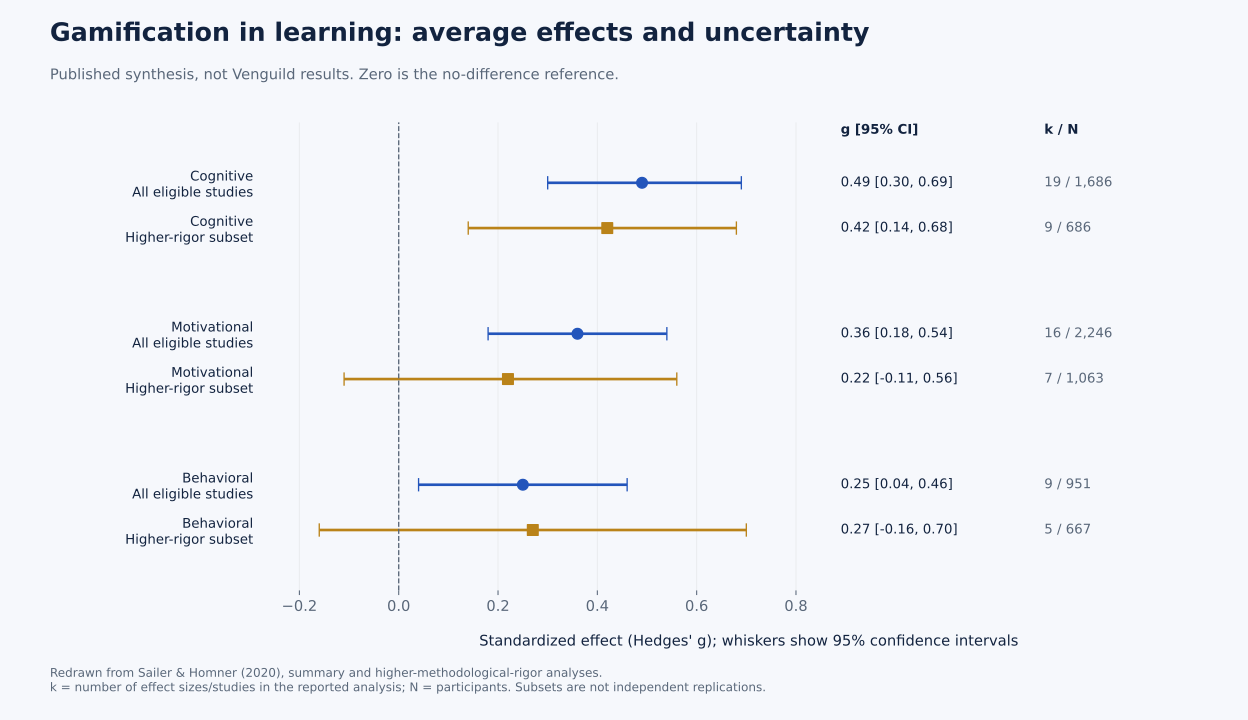
Sailer and Homner’s learning meta-analysis reported positive average effects across cognitive, motivational and behavioral outcomes. In its higher-methodological-rigor subsets, the motivational and behavioral intervals included zero. The smaller subsets also limit precision. This supports cautious interest, not a guaranteed effect for a career platform. [10]
Li, Hew and Du’s review reported a small intrinsic-motivation effect across 35 interventions involving 2,500 participants. Estimates differed across perceived needs, and their intervals varied substantially. Perceived competence is not a direct assessment of skill. [11]
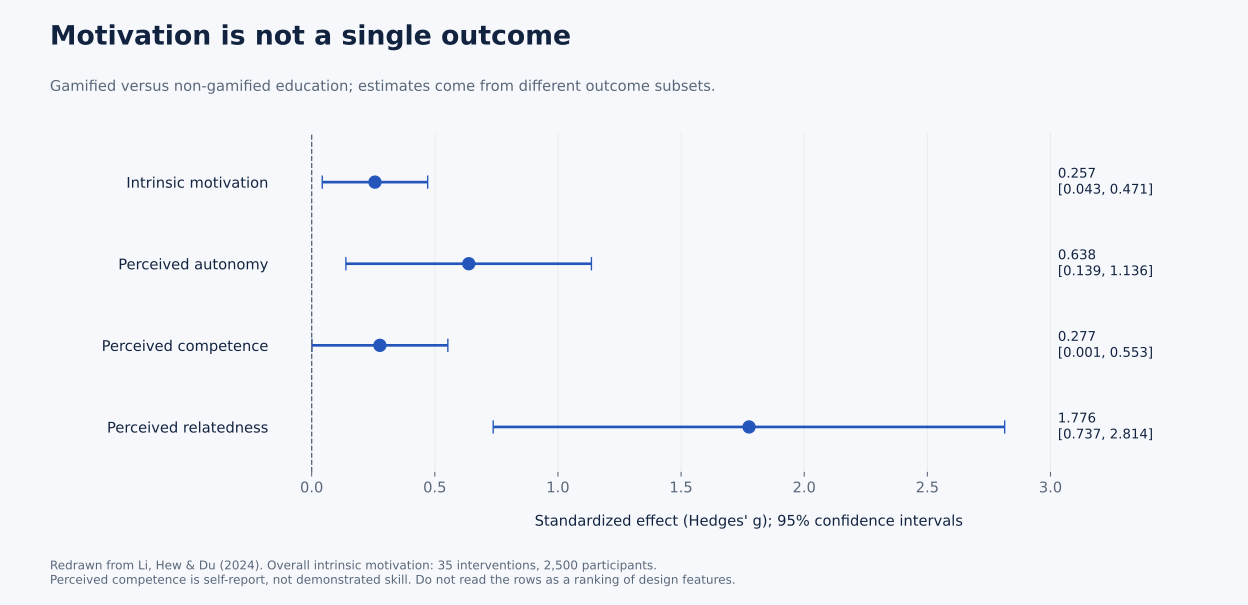
How to read these graphs: a dot is a standardized mean-difference estimate, Hedges’ g; the horizontal line is its reported uncertainty interval. A value of 0.49 does not mean a 49% improvement. The zero line represents no average difference on this standardized scale. Neither graph measures a person’s worth, probability of employment or future earnings.
A more recent mathematics-focused review by Ratinho and colleagues, published in February 2026, found a positive motivation estimate across 11 studies in its meta-analysis. Engagement could not be pooled because sufficiently validated measures were lacking. That adds context from another educational setting, not confirmation of Venguild’s proposed mechanism. [12]
The broader message is that the design, setting, outcome and quality of evidence matter. It would be misleading to combine these reviews into one grand success rate, or to carry educational estimates directly into careers, community life or long-term personal development.
The experience–role–action connection
Our name for the central design framework is Role-Centered Participatory Gamification, or RCPG. Its unit is a connection the participant understands and endorses: something they contributed, a role that gives it a possible interpretation, and an action they may choose next.
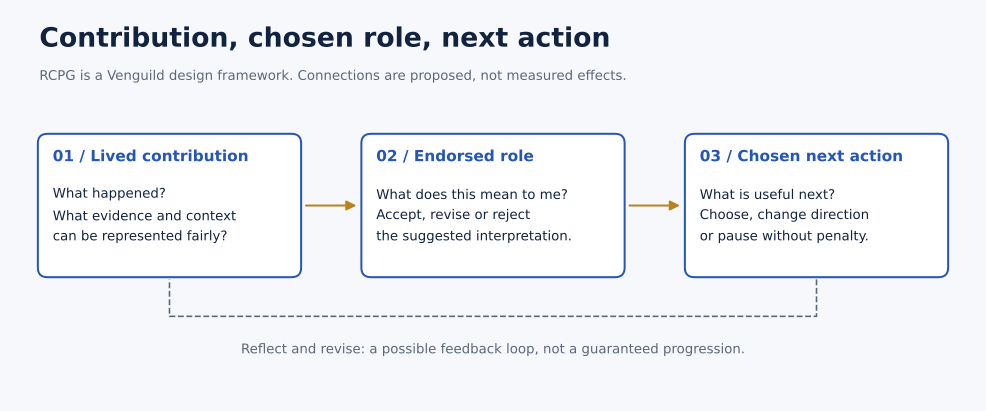
Return to the classmate example. The factual record could explain what help was given and what evidence is available. A possible interpretation could be “mentor,” “explainer” or a fantasy scholar. The participant might accept one, change it, or prefer no thematic role. A next action might be preparing a resource, joining a peer-learning group or exploring a different skill.
The contribution should not lock the person into a future. Being good at explaining something once does not oblige someone to become a teacher. The role offers a vocabulary for reflection; the person decides whether it fits.
This is what the connection could add beyond a badge: an explanation of how a record relates to a direction the participant can revise. The additional value remains unproven. A well-organized factual history might work just as well for some people. An appealing narrative might help without the role component doing anything distinct.
Rogers and colleagues’ eight-study paper offers a relevant precedent for narrative framing and meaning in life. It includes restorying interventions built around a Hero’s Journey account. It supports taking narrative interpretation seriously, while leaving open whether Venguild’s particular linkage helps, lasts, or suits different participants. [13]
We should also allow stories of maintenance, mutual care, recovery and steady craft. A person does not need a dramatic transformation to have a worthwhile life. Someone keeping a team functioning may contribute more than the person making the most impressive announcement.
The whole tree is the World Tree Engine
The World Tree Engine, or WTE, is Venguild’s architecture spanning three functional layers. The whole tree is the engine. Its middle layer performs translation, but WTE is not merely a points calculator or the illustration of a tree.

Reality: what happened, with context
The Reality Layer grounds a representation in education, work, learning, activities and contributions. Evidence and uncertainty belong here. A system should distinguish a participant’s account, supporting material and the limits of what can reasonably be inferred.
Gamified: how eligible inputs become possibilities
The Gamified Layer maps and connects eligible inputs into progression and available resources. Its explanations matter as much as its output. Someone should be able to understand the basis of a representation and challenge an inaccurate input. The diagram describes functions; it does not disclose formulas or claim that a system can fully measure identity.
Fantasy: what the person chooses to do
The Fantasy Layer offers characters, skills, quests and world activities. Experience can inform available possibilities without determining a compulsory character. People with similar histories might make different choices. Some might prefer to retain resources, follow another direction, or not participate.
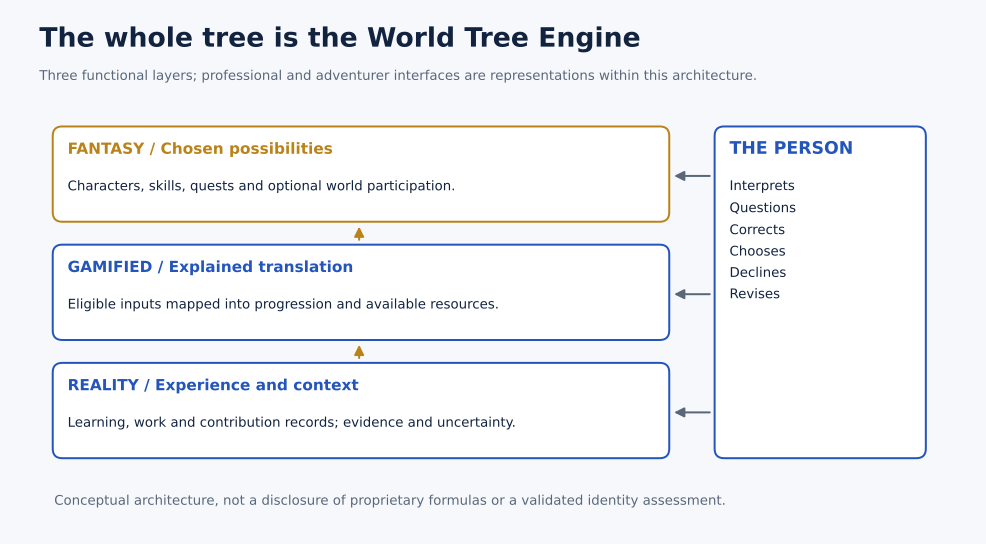
Suppose a participant helps complete a community project. Reality retains the activity and its context. Gamified rules explain which progression or resources are available. Fantasy provides optional ways to use them. A clear professional record remains important throughout; a fantasy rank should not become a substitute for a qualification.
Yee and Bailenson’s avatar experiments show that changed self-representation can influence behavior in controlled virtual interactions. They do not establish durable gains in workplace ability or learning. An avatar can be psychologically relevant without becoming a valid assessment of the person behind it. [14]
What responsible progress would look like
The most persuasive demonstration would go beyond showing that people like the artwork. We need to know whether they understand the representation, can revise it, find the next action useful, and experience acceptable levels of pressure and misrecognition.
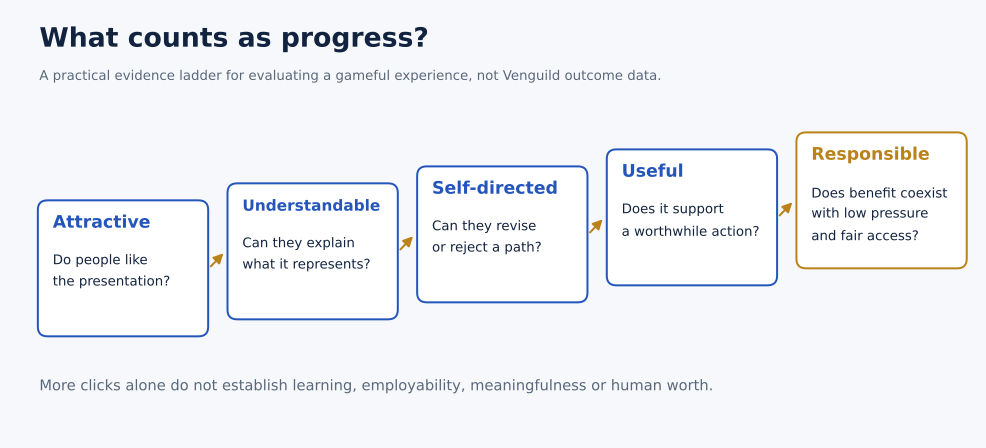
A fair comparison would hold visual quality and basic game elements reasonably constant while examining what the explicit connection adds. If the linked explanation performs no better than the same information shown separately, we should narrow the claim. If people enjoy it but cannot correct their role, enjoyment does not settle the question of agency.
Likewise, an early improvement in reported meaning would not demonstrate years of development. Work, study, health, relationships and economic conditions continue outside the platform. People who remain active may differ from those who leave. Long-term association alone would not isolate a product’s causal effect.
We also need to hear from people who prefer not to use the system. Non-use can signal a problem, a different preference, changed circumstances, or a healthy decision that the tool is no longer needed. It should not automatically be scored as personal failure.
These are standards for evaluating our ideas, not an announcement that the underlying Venguild studies have been completed. At this stage, the RCPG-specific benefit remains a design hypothesis.
Five principles I want the product to earn
- Make the basis legible. Explain what record supports an output, what remains uncertain, and how an error can be corrected.
- Keep identity revisable. A suggested role should help someone reflect, not become a permanent label or a personality verdict.
- Respect refusal and rest. The option to pause must remain meaningful; constant activity is not a synonym for agency.
- Recognize reciprocal work. Designing, maintaining, mentoring and helping should remain visible without requiring everyone to compete for a public stage.
- Match claims to evidence. Enjoyment, self-reported meaning, demonstrated skill and actual opportunity are different outcomes. Report them accordingly.
These principles also protect the ambition. If the premise is that ordinary effort can connect with a meaningful direction, the platform must avoid becoming another place where people feel compelled to prove that they are continuously extraordinary.
I want Venguild to make room for a quieter sentence: “This mattered, I understand why, and I can choose what comes next.” That is a worthwhile direction to build toward, even before we know how well a particular implementation will work.
Questions worth keeping open
Does Venguild claim that life is literally a game?
No. It draws design ideas from play while retaining the difference between voluntary participation and obligations with real consequences.
Is RCPG an established psychological theory?
It is Venguild’s proposed framework connecting experience, an endorsed role and a next action. The established theories discussed here inform it; they do not validate its incremental benefit.
Do these graphs show Venguild’s performance?
No. They redraw published estimates from educational gamification reviews. The conceptual diagrams explain Venguild’s design ideas.
Does a fantasy character prove professional competence?
No. Professional capability requires appropriate evidence. A character can express aspiration or participation without certifying a skill.
Must people enjoy fantasy to benefit from a useful record?
No. A conventional account may be enough. Whether an additional gameful interpretation adds value should depend on the person and evidence, not a requirement to adopt the aesthetic.
References and chart data
This is a research-informed journal essay, not an original empirical results paper or a completed systematic review. The author leads Venguild and has a commercial interest in its development. Examples are illustrative, not participant case reports. External sources were checked on 4 November 2026; some publisher pages provide abstracts rather than unrestricted full text. DOI links identify the cited publications. No external author or institution is presented as endorsing Venguild.
- Cotter, K. (2019). Playing the visibility game: How digital influencers and algorithms negotiate influence on Instagram. New Media & Society, 21(4), 895–913. DOI: 10.1177/1461444818815684.
- Mead, G. H. (1934). Play, the Game, and the Generalized Other. Section 20 in Mind, Self, and Society, 152–164. University of Chicago Press; primary text hosted by the Mead Project.
- Caillois, R. (1961; original 1958). Man, Play and Games (M. Barash, trans.). Linked publisher page describes the later University of Illinois Press edition.
- Deterding, S., Dixon, D., Khaled, R., & Nacke, L. (2011). From game design elements to gamefulness: Defining “gamification.” Proceedings of MindTrek ’11, 9–15. DOI: 10.1145/2181037.2181040.
- Lillard, A. S., Lerner, M. D., Hopkins, E. J., Dore, R. A., Smith, E. D., & Palmquist, C. M. (2013). The impact of pretend play on children’s development: A review of the evidence. Psychological Bulletin, 139(1), 1–34. DOI: 10.1037/a0029321.
- McAdams, D. P., & McLean, K. C. (2013). Narrative identity. Current Directions in Psychological Science, 22(3), 233–238. DOI: 10.1177/0963721413475622.
- Bandura, A. (2001). Social cognitive theory: An agentic perspective. Annual Review of Psychology, 52, 1–26. DOI: 10.1146/annurev.psych.52.1.1.
- Ryan, R. M., & Deci, E. L. (2000). Self-determination theory and the facilitation of intrinsic motivation, social development, and well-being. American Psychologist, 55(1), 68–78. Author-hosted full text.
- Sailer, M., Hense, J. U., Mayr, S. K., & Mandl, H. (2017). How gamification motivates: An experimental study of the effects of specific game design elements on psychological need satisfaction. Computers in Human Behavior, 69, 371–380.
- Sailer, M., & Homner, L. (2020; online 2019). The gamification of learning: A meta-analysis. Educational Psychology Review, 32, 77–112. DOI: 10.1007/s10648-019-09498-w. Figure 1 uses the reported summary and higher-rigor estimates; no pooled estimate was recalculated.
- Li, L., Hew, K. F., & Du, J. (2024; online 2023). Gamification enhances student intrinsic motivation, perceptions of autonomy and relatedness, but minimal impact on competency: A meta-analysis and systematic review. Educational Technology Research and Development, 72, 765–796. DOI: 10.1007/s11423-023-10337-7. Figure 2 uses reported estimates and intervals.
- Ratinho, E., Figueiredo, M., Estêvão, D., Faísca, L., & Martins, C. (2026). Gamification on mathematics engagement and motivation in secondary school and higher education: A systematic review and meta-analysis. Educational Psychology Review, 38, Article 16. DOI: 10.1007/s10648-025-10108-1.
- Rogers, B. A., Chicas, H., Kelly, J. M., Kubin, E., Christian, M. S., Kachanoff, F. J., Berger, J., Puryear, C., McAdams, D. P., & Gray, K. (2023). Seeing your life story as a Hero’s Journey increases meaning in life. Journal of Personality and Social Psychology, 125(4), 752–778.
- Yee, N., & Bailenson, J. (2007). The Proteus effect: The effect of transformed self-representation on behavior. Human Communication Research, 33(3), 271–290. Author-hosted manuscript.
- Almeida, C., Kalinowski, M., Uchoa, A., & Feijó, B. (2023). Negative effects of gamification in education software: Systematic mapping and practitioner perceptions. Information and Software Technology, 156, 107142. Open manuscript.
- Nielsen, M., & Haun, D. (2016). Why developmental psychology is incomplete without comparative and cross-cultural perspectives. Philosophical Transactions of the Royal Society B, 371(1686), 20150071.
Conceptual diagrams were created for this essay. Statistical graphs redraw reported values rather than reproduce publisher artwork. CSV files contain only the plotted summary estimates. Study populations, measures and contexts differ; these are not results of a Venguild trial. The two editorial illustrations were generated with AI.
Continue the conversation
Explore Venguild’s technology direction, read the founder’s journal on building with AI, or contact us about the questions this essay raises.